The format is close to fixed, which is good news. You are not designing a document so much as filling a known shape well.
The six sections
1. Core competencies
What you do, as phrases rather than sentences. "Structural steel erection" beats "We provide comprehensive structural steel erection services to a wide range of clients." Six to ten items, no more.
2. Past performance
Three to five contracts. Agency or client name, contract value, dates, and one line on what you delivered. Buyers look here first, and an empty section here costs you more than a plain layout does.
3. Differentiators
The section most companies write badly. "Quality workmanship" and "customer focus" are not differentiators, because your eleven competitors wrote the same words. A differentiator is something a competitor cannot claim: a certification they lack, equipment they do not own, a clearance level, a response time you contractually guarantee.
4. Company data
For US federal work: UEI, CAGE code, NAICS codes, and your business size classification. This is reference data. It should be findable in two seconds and should not be styled to look interesting.
5. Certifications and set-aside status
8(a), HUBZone, SDVOSB, WOSB, and any state-level equivalents. If you hold one, it goes near the top, because for some solicitations it is the only thing that matters.
6. Contact
One name, one phone number, one email. Not a general inbox. A buyer with a question and a deadline will call the number that reaches a person.
What to leave out
- Mission and vision statements. Nobody awards a contract on a mission statement.
- Company history. "Founded in 1998 by..." is website content.
- Team photos and bios. Unless a specific solicitation asks for key personnel, cut them.
- Stock photography. It consumes the space your past performance needs.
- Extra pages that repeat the website. A page earns its place by carrying proof, not by making the document feel heavier.
- 01
Core competencies
Six to ten phrases, not sentences.
- 02
Past performance
Three to five contracts with client, value, and dates.
- 03
Differentiators
Only things a competitor cannot also claim.
- 04
Company data
UEI, CAGE, NAICS, size classification.
One page, or a real document?
For federal contracting, one page, and design it to survive being printed in black and white on an office printer. Contracting officers read these in stacks, so your company name goes in a band across the top where it is identifiable at a glance, and body text stays at 9 or 10 point so it holds up on a photocopy.
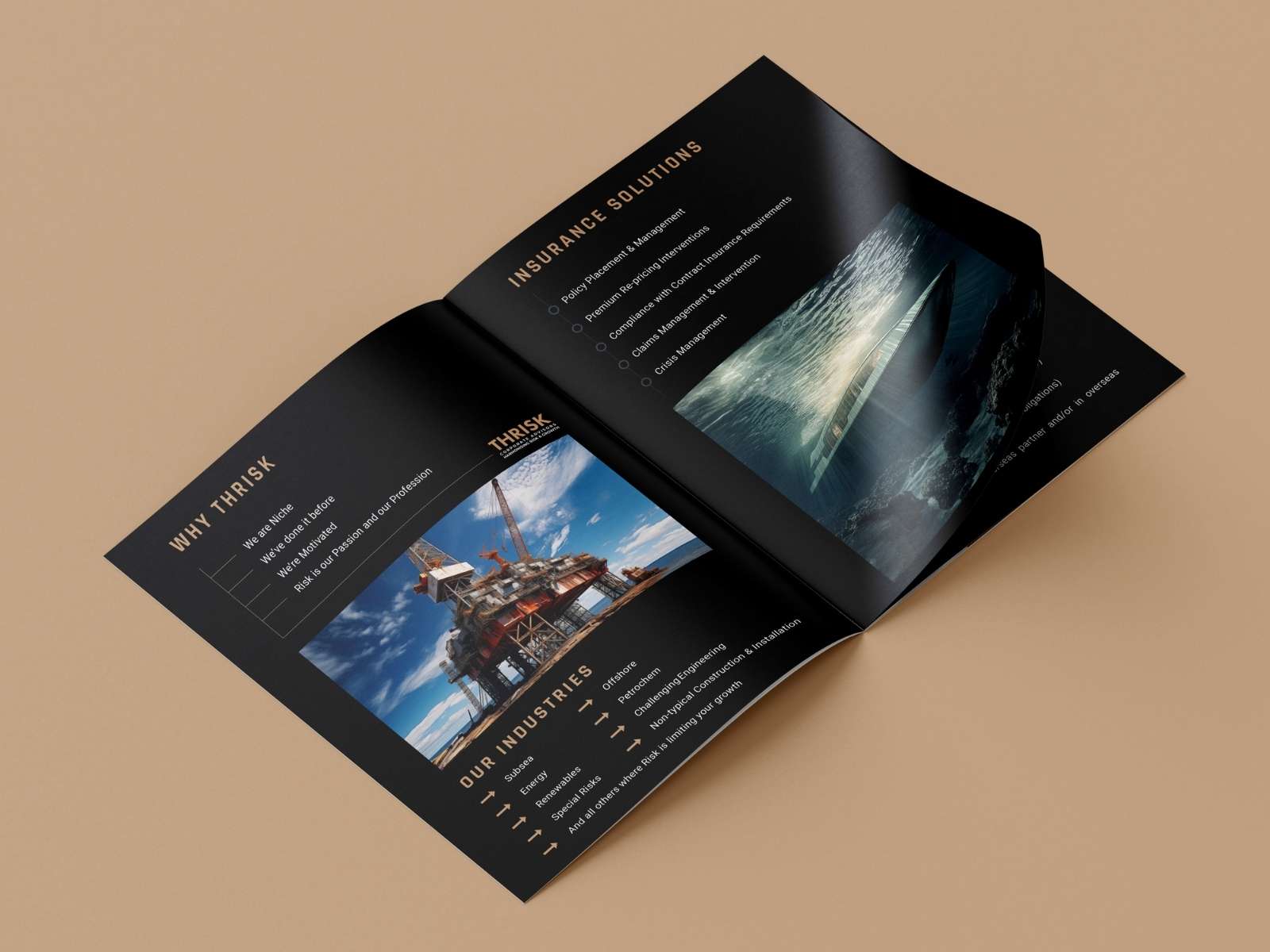
For commercial buyers the calculation changes. A firm selling risk advisory to insurers, or construction services to a developer, is not competing for a forty-second scan — it is being evaluated. That is where the multi-page capability document earns its length: the same six sections, but each with room for proof. THRISK Corporate Advisors' 12-page capability statement is that format — services, engagement history, and team credentials, one topic per spread.
The test for every extra page is the same either way: does it carry proof a buyer needs, or does it just make the document feel more substantial to you? Cut a paragraph before you add a page.
The version question
Keep one master and produce variants per agency or per market, not per opportunity. Rewriting the differentiators for every solicitation is a good instinct that becomes a full-time job. Two or three versions, updated annually, is the practical compromise.
For what the design work costs, see capability statement pricing — the short version is $80 to $450 flat, by page count.